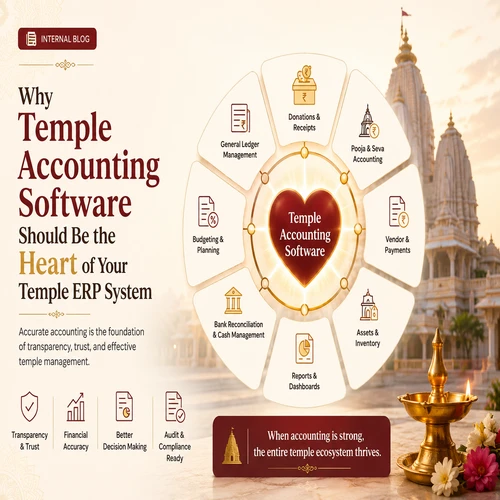
Why Temple Accounting Software Should Be the Heart of Your Temple ERP System
A practical guide for temple administrators, executive officers, and trust board members who are tired of financial chaos — and ready to do something about it.
There's a scene that plays out in hundreds of temples across South India every year.
It's the day before the annual audit. Your accountant has been at the desk since 6 AM. Three months of hundi collection registers are spread across the table. The donation counter software exports don't match the handwritten ledger. The festival expense file is somewhere in a folder on a laptop that was last opened in March. Someone sent a WhatsApp message asking about the 80G receipt for a ₹50,000 donation made in February. Nobody knows where it is.
By evening, the accountant has a headache. You have anxiety. The auditor is arriving at 10 AM.
If this sounds familiar — you don't have an accounting problem. You have a systems problem. And the fix isn't working harder. It's using the right tool.
The Hidden Cost of Running Temple Finances the Old Way
Most temples in India — even large, well-run ones — are still managing their finances using a patchwork of tools that were never designed for religious trusts.
Tally for basic accounts. Excel for donation summaries. A separate counter software for seva bookings. Handwritten hundi count registers. WhatsApp for sharing reports with the board.
Each of these tools works fine in isolation. But together, they create something dangerous: data that lives in five different places and never fully agrees with itself.
The cost of this isn't just accountant stress. It's real, measurable, and compounding:
- Every month, your team spends 15–25 hours manually reconciling data that should reconcile itself automatically.
- Every festival season, donation volumes spike — and so do errors.
- Every time a devotee asks for an 80G receipt, someone has to dig through two systems to generate one.
- Every audit, you're recreating a paper trail that should have been building itself all year.
- Every board meeting, the financial report is either late, incomplete, or both.
This is the hidden cost of running temple finances without integrated accounting software. It's not just inefficiency — it's risk. Audit risk. Compliance risk. Donor trust risk.
Download Our Temple ERP Brochure — See Every Feature in Detail
No commitment. We'll walk through your specific Temple ERP Software setup and show you exactly what's possible.
What Makes Temple Accounting Different from Regular Accounting
Before we talk about software, let's be honest about something: temple accounting is genuinely different from business accounting. And this is why generic tools like Tally, QuickBooks, or even most NGO accounting software struggle to serve temples properly.
Here's what makes temple finances unique:
Fund accounting is mandatory, not optional. A temple doesn't just have "income" and "expenses." It has an Annadanam Fund, a Renovation Fund, an Endowment Corpus, daily puja collections, special event seva income, HR&CE remittances, and sometimes dozens of sub-trusts — all with separate legal obligations. Your accounting system must keep these absolutely separate. If it doesn't, you're one audit observation away from serious trouble.
Income is irregular and high-volume. On a normal Tuesday, your temple might collect ₹12,000. On Karthigai Deepam, it might collect ₹12 lakhs. Your accounting system needs to handle both — with the same accuracy, the same speed, and no bottleneck at the counter.
Donor documentation is a legal requirement. Every donation above ₹2,000 in cash (and all UPI/bank donations) requires proper documentation. 80G receipts must be issued for eligible donors. This isn't optional — it's part of your trust's obligations under the Income Tax Act and your HR&CE or Devasthanam Board registration.
Multiple reporting standards apply. You're not just filing a balance sheet. You're producing Receipts & Payments accounts, Income & Expenditure statements, fund-wise schedules, and board reports — often in specific formats required by your statutory authority.
A generic accounting tool handles none of this. A purpose-built temple accounting module handles all of it — automatically.
What Temple Accounting Software Actually Does
Let's walk through what a good temple accounting module looks like in daily practice — not in marketing language, but in terms of what your team actually experiences.
Every Rupee Collected Posts Automatically
When a devotee pays for an Abhishekam at your counter — whether in cash, UPI, card, or through your online booking portal — that transaction posts directly to the correct ledger in real time. The seva fee goes to the seva income fund. The donation goes to the appropriate donation fund. The GST, if applicable, is separated.
Your cashier doesn't have to enter anything twice. Your accountant doesn't have to import anything at the end of the day. It just happens.
Hundi Collections Are Counted, Verified, and Posted
Hundi counting is one of the most time-sensitive and error-prone processes in temple administration. With integrated accounting, your hundi verification process ties directly into your ledger — so the moment the count is confirmed and entered, it's posted. Discrepancies show up immediately, not three weeks later.
80G Receipts Go Out the Same Day
When a devotee donates above your threshold, the system generates a compliant, numbered 80G receipt automatically and delivers it via SMS and email within minutes. No manual generation. No receipts sitting in a queue waiting to be processed. Donors get their documentation the same day — and they notice.
Festival Finances Run on Their Own Budget
For every major festival — Brahmotsavam, Thai Pongal, Aadi Perukku, Navarathri — you can set up a separate budget within your system. Income from festival sevas, prasadam sales, and special donations flows into the festival account. Expenses for decorations, priests, food, and arrangements are recorded against it. At the end of the festival, you have a complete P&L — not because someone built it in Excel, but because the system built it for you.
Audit Reports Generate in One Click
Your statutory auditor will ask for a Balance Sheet, Income & Expenditure Account, Receipts & Payments Account, and fund-wise schedules. With a proper temple accounting module, all of these generate in minutes — formatted for Indian trust accounting standards, compliant with your HR&CE or Devasthanam Board requirements, and ready to hand over.
No recreation. No scrambling. No late nights before audit day.
Explore All Temple Accounting Features — See the Full Module Breakdown
Why Accounting Cannot Be a Separate Tool — It Must Be Inside Your ERP
This is the most important point in this entire article, so we're going to spend a moment on it.
Many temples buy a donation management system. Then they use a separate accounting tool. Then they try to connect them with a monthly Excel export. And every month, they wonder why the numbers don't match.
The reason is simple: when two systems are separate, they have two versions of truth. And those versions will always diverge, because data is entered differently, at different times, by different people, with different assumptions.
When accounting is built inside your Temple ERP — not connected to it, not integrated with it, but actually built into it — there is only one version of truth. The donation that the counter team records is the same entry the accountant sees. The seva booking that the front desk confirms is already in the ledger. Nothing has to be exported, imported, or reconciled.
This changes the entire experience of running temple finances. It goes from reactive — fixing problems after they happen — to proactive — where problems can't happen in the first place because the system prevents them.
Here's the complete data flow in an integrated system:
Devotee arrives → Seva selected → Payment collected → Ledger posted automatically → Fund allocation applied → 80G generated (if applicable) → Board report updated → Audit trail recorded
Every step. One system. Zero manual handoffs.
Download Our Temple Erp Software Quotation — Based On Your Size and Requirements
Make sure your next temple accounting system can handle everything your temple actually needs.
Is Your Temple Ready for This? A Honest Self-Assessment
Read through these. Be honest with yourself.
You need temple accounting software now if:
- Your annual donation volume exceeds ₹15 lakhs
- You manage more than two funds (general, renovation, endowment, etc.)
- Your accountant spends more than 3 days per month on reconciliation
- You've ever received an audit observation related to your accounts
- Your donors ask for 80G receipts and get them more than 3 days later
- You've had discrepancies between your hundi count and your books in the last 12 months
- Your board or EO has asked for a financial report and had to wait more than a week
- You're preparing for an HR&CE, Devasthanam Board, or Income Tax audit in the next 6 months
- You're planning a major renovation or expansion and need to manage dedicated funds
- Your temple is growing — more devotees, more sevas, more festivals — and your current system isn't keeping up
If three or more of these apply to your temple, you're already overdue. The question isn't whether to implement integrated accounting — it's how soon.
What to Ask Any Temple Software Vendor Before You Decide
Not all temple ERP vendors build their accounting module the same way. Some bolt on a generic accounting tool. Some offer a "sync" with Tally. Some build a basic ledger that handles simple transactions but falls apart during festival season.
Here are the questions that separate serious vendors from the rest:
1. Is your accounting module natively built into the ERP, or is it a third-party integration?
If it's a third-party integration, you will have sync errors. It's not a question of if — it's when.
2. Does your system support fund accounting — not just account heads, but genuinely separate fund ledgers?
Ask for a live demo of how two separate funds are maintained and how cross-fund transactions are prevented.
3. Can your system generate the exact reports required by HR&CE or our specific Devasthanam Board?
Ask them to show you a sample report. If they hesitate, that's your answer.
4. How does your system handle hundi counting and posting?
This is a uniquely temple requirement. If the vendor doesn't have a clear, specific answer, they haven't built for temples.
5. How does 80G receipt generation work — manual, batch, or real-time automatic?
Real-time automatic is the standard you should expect. Batch processing means delays. Manual means more work for your team.
6. What happens during festival season when transaction volumes spike significantly?
Ask about performance. Ask about load testing. Ask what their busiest temple client looks like and whether they handled it smoothly.
7. Is your team experienced with Indian religious trust accounting and compliance?
Temple accounting has specific requirements under the Income Tax Act, the HR&CE Act, and various state Devasthanam Board regulations. Your vendor needs to understand these — not just generally, but specifically.
What Changes When You Get This Right
We work with temples that have implemented integrated accounting, and the change they describe isn't just operational — it's emotional.
The accountant who used to dread the first week of every month now closes the books on the last day. The executive officer who couldn't answer a board member's question about festival fund utilization now pulls up the report in 30 seconds. The devotees who waited two weeks for their 80G receipts now receive them while they're still in the temple premises.
That's not just efficiency. That's the kind of trust that makes devotees come back, donate more, and tell others about their experience.
Temple administration has always been an act of service. The right software doesn't change that — it frees your team to focus on it, instead of spending their energy on spreadsheets.
The Cost of Waiting One More Festival Season
We want to be direct with you about something.
Every festival season you go through without integrated accounting adds to a backlog that gets harder to clean up. Unreconciled entries accumulate. Audit risk compounds. Donor records get messier. And the amount of work required to migrate to a proper system increases.
There's no perfect time to implement new software. But there are bad times — like two weeks before a major festival or right in the middle of an audit. If you're reading this now, before the next big season, this is the right window.
Schedule Your Free Demo This Week — Spots Are Limited
We offer a personalised 30-minute walkthrough tailored to your temple's size, trust structure, and compliance requirements. We speak Tamil, Telugu, Kannada, and English — and we understand temple operations deeply, not just accounting software.
What happens in the demo:
- We review your current accounting workflow and identify specific pain points
- We show you exactly how our integrated system handles your temple's transactions
- We walk through the reports your auditor, board, and HR&CE will actually receive
- We give you a realistic implementation timeline and what onboarding looks like
No sales pressure. No generic pitch. Just a practical conversation about whether this is the right fit for your temple.
Talk to Our Temple ERP Team — Call, WhatsApp, or Fill the Form