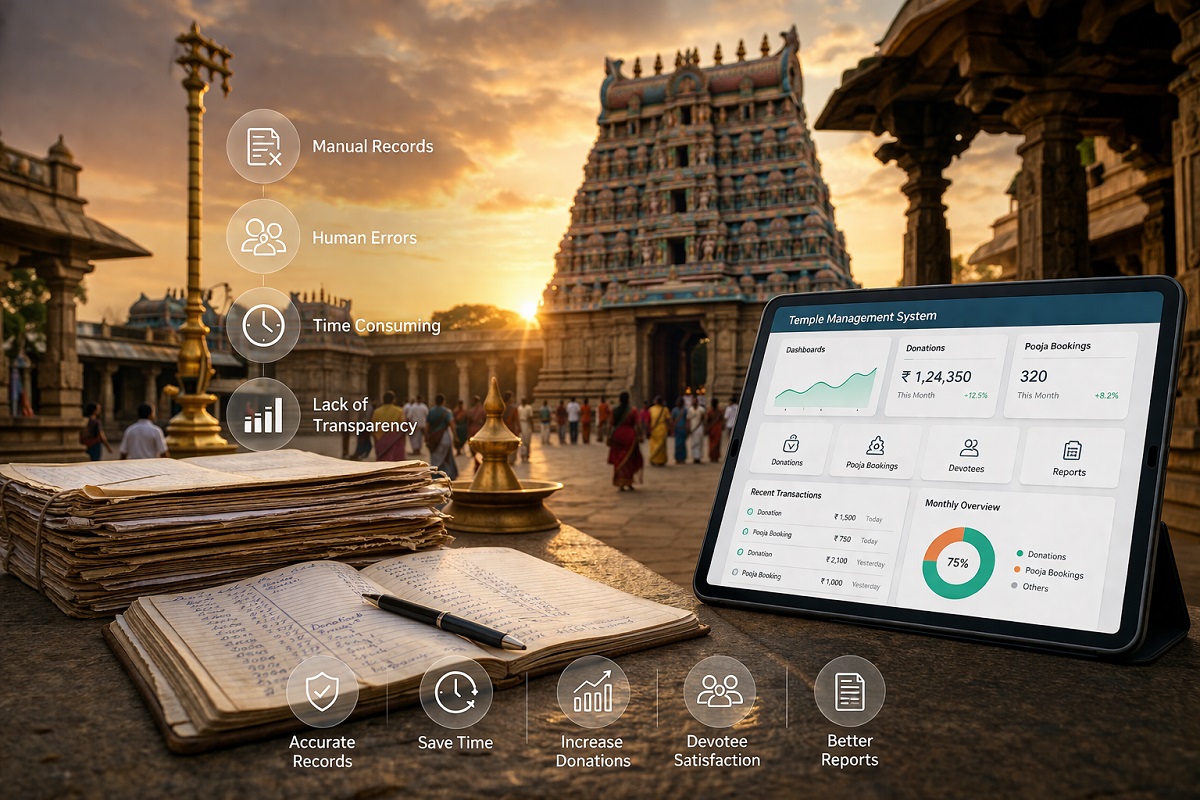
Manual Temple Management Is Costing You More Than You Think
Many temples still rely on manual registers, handwritten receipts, and disconnected systems to manage daily operations. At first, this may seem manageable. But over time, these manual processes start creating serious problems.
From missing donation records to confusion in pooja bookings, the cracks begin to show. Temple administrators and trustees often struggle to maintain accuracy, transparency, and efficiency.
If your temple is still running on manual systems, you may already be losing more than you realize.
If your temple is already facing these challenges, it may be time to explore a better way to manage operations.
The Real Problems with Manual Temple Management
1. Errors in Donation Tracking
Manual entries increase the risk of mistakes. Even a small error in recording donations can lead to financial discrepancies and loss of trust among devotees.
2. Confusion in Pooja and Booking Management
Handling pooja schedules manually often leads to double bookings, missed entries, or miscommunication with devotees.
3. Heavy Dependency on Staff
When everything depends on a few individuals, operations become slow and risky. If a staff member is unavailable, the entire workflow gets affected.
4. Lack of Transparency
Manual systems make it difficult to provide clear financial reports. This can create doubts among temple committees and devotees.
If these issues sound familiar, continuing with manual processes will only make things harder over time.
Explore more about automated temple management system here.
The Hidden Costs You Might Be Ignoring
Financial Loss
Untracked or mismanaged donations can directly impact temple income.
Time Wastage
Manual processes consume valuable time that could be used to improve temple services.
Devotee Dissatisfaction
Delays, errors, and poor communication reduce the overall devotee experience.
Reputation Damage
A lack of proper management can affect the temple’s credibility and trust.
The Smart Solution: Temple Management Software
To overcome these challenges, temples are now adopting digital systems that simplify and streamline operations.
A modern temple management system helps automate daily tasks, reduce errors, and improve overall efficiency.
These hidden costs can be avoided with the right digital solution in place.
How Digital Systems Transform Temple Operations
Automated Donation Tracking
Every transaction is recorded accurately, ensuring complete transparency.
You can integrate a temple POS system for faster and error-free billing at counters.
Easy Pooja and Booking Management
Devotees can book poojas without confusion, and administrators can manage schedules effortlessly.
A self-service kiosk system can further simplify on-site bookings and reduce queues.
Centralized Data Management
All records are stored in one place, making it easy to access and manage information.
Real-Time Reporting
Temple committees can track income, expenses, and activities instantly.
See how your temple can manage everything in one place with a simple digital system.
Key Benefits for Your Temple
- Improved accuracy in financial management
- Faster and smoother daily operations
- Better devotee experience
- Increased transparency and trust
- Reduced dependency on manual work
Take the Next Step Toward Smarter Temple Management
Manual systems will continue to create challenges as your temple grows. Switching to a digital system is no longer optional—it’s necessary.
Book a free demo today and experience how your temple operations can be simplified.
FAQs
1. What are the problems with manual temple management?
Manual temple management leads to errors in records, lack of transparency, booking confusion, and inefficiency in daily operations.
2. How does temple management software help temples?
It automates processes like donation tracking, pooja booking, and reporting, improving accuracy and efficiency.
3. Can temple software improve donation tracking?
Yes, it records every transaction digitally, reducing errors and ensuring transparency.
4. Is temple management software suitable for small temples?
Yes, it can be customized based on the size and needs of the temple.
5. How does a kiosk system help temples?
A kiosk allows devotees to book services and make payments easily, reducing queues and manual workload.
6. Why should temples switch to digital systems?
Digital systems save time, reduce errors, improve transparency, and enhance the overall devotee experience.